
Canada's Mortgage Knowledgebase & News
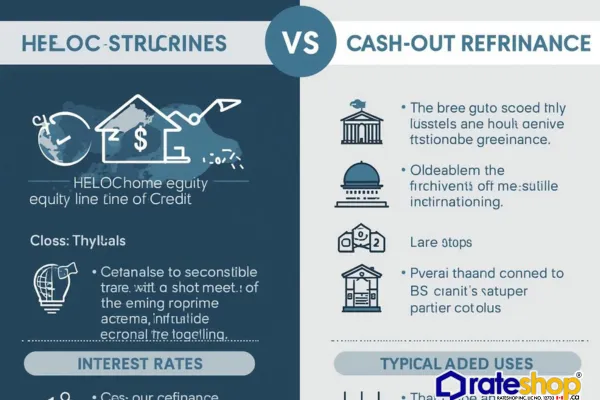
HELOC vs Cash-Out Refinance
H1: Home Equity Options: HELOC vs Cash-Out Refinance — What to Choose
H2: Introduction – The HELOC vs Cash-Out Refinance Dilemma
If you’re a homeowner sitting on built-up equity, you might be asking:What’s the best way to tap home equity in 2025? Two of the most popular choices are a Home Equity Line of Credit (HELOC) and a cash-out refinance. Both unlock the value of your home, but they work differently, with unique pros and cons.
At Rateshop, we often get asked: Should I use a HELOC or go with a cash-out refinance? The answer depends on your goals, financial situation, and even current mortgage rates.
In this guide, we’ll break down theHELOC vs cash-out refinance comparison, including:
HELOC interest rate variable vs cash-out refinance fixed rate structures
Which is better for home improvements, debt consolidation, or tuition
A real-world look at closing costs and repayment flexibility
H2: Understanding the Basics – HELOC vs Cash-Out Refinance
H3: What Is a HELOC?
A Home Equity Line of Credit works like a credit card secured by your home. You get a revolving credit line based on the equity you’ve built.
Repayment period: After the draw, repayment begins (often 10–20 years).
HELOC interest rate variable: Rates move with the prime rate, making payments flexible but unpredictable.
H3: What Is a Cash-Out Refinance?
A mortgage cash-out refi replaces your existing mortgage with a larger one, giving you the difference in cash.
Fixed-rate stability: Most choose a cash-out refinance fixed rate, which locks in predictable payments.
Lump sum: Funds are received upfront.
Impact on mortgage: Extends or resets your term, and you may lose your old low rate if you had one.
H2: Side-by-Side Comparison – Lump Sum vs Line of Credit
H2: Which Home Equity Option Fits Your Goals?
H3: For Home Improvements
HELOC: Great for phased renovations where costs come in stages. Example: adding a deck now, finishing a basement later.
Cash-Out Refinance: Ideal if you have a one-time large project (like a kitchen remodel) with fixed costs.
H3: For Debt Consolidation
Cash-Out Refinance Fixed Rate is often better, as it rolls high-interest debt into one predictable mortgage payment.
HELOC interest rate variable may start lower but could increase, making it risky for long-term consolidation.
H3: For Tuition or Education Costs
HELOC draw period flexibility works well for paying semester by semester.
But if you prefer a predictable fixed payment, a cash-out refinance may provide peace of mind.
📸Visual Placement #4 (Infographic)
H2: The Cost Factor – Closing Costs & Fees
One of the biggest differences between these two options is cost.
Cash-Out Refinance: Higher, sinceit’s a full refinance. Think appraisal, legal fees, title insurance, and potential penalties for breaking your old mortgage.
Tip: If your current mortgage rate is much lower than today’s average, a cash-out refinance may be expensive in the long run. (See thisBank of Canada mortgage rate tracker).
H2: When a HELOC Makes More Sense
You need flexibility, not a lump sum.
You want quick access to equity without disturbing your existing mortgage rate.
You expect rates to drop, making variable borrowing cheaper.
👉 Explore home equity line of credit options and find today’s best offers.
H2: When a Cash-Out Refinance Wins
You want predictable payments with a fixed rate.
👉 Use our quick mortgage quote tool to compare if refinancing saves you money.
H2: Common Questions About HELOC vs Cash-Out Refinance
H3: Is a cash-out refinance worth it if my current mortgage rate is low?
Usually not. You’d risk trading a low rate for a higher one. A HELOC might be better here.
H3: How does a cash-out refinance affect my existing mortgage term?
It resets your term—if you had 20 years left, you may now have a fresh 25- or 30-year mortgage.
H3: What’s cheaper in the short run?
H3: Can I combine strategies?
Yes—some homeowners do a partial cash-out refinance for debt consolidation and keep a small HELOC for future flexibility.
H2: Real-World Example – Choosing the Right Option
Let’s take “Sarah,” a homeowner in Ontario:
She owes $250,000 on a mortgage with a 2.1% rate from 2021.
Her home is now worth $600,000, and she needs $50,000 for renovations and $20,000 for her child’s tuition.
If she refinanced, she’d lose her 2.1% rate and replace it with today’s ~5.5%—doubling her monthly payments. Instead, aHELOC makes sense: she can borrow only what she needs, keep her low mortgage, and pay tuition in installments.
This scenario shows why home equity options comparison must be personalized.
H2: Conclusion – Which Option Should You Choose?
When it comes to HELOC vs cash-out refinance, there’s no universal answer. It depends on your goals, mortgage rate, and how you plan to use the funds.
Choose a HELOC if you value flexibility, phased spending, and want to keep your low mortgage rate intact.
Choose a cash-out refinance if you need a lump sum for debt consolidation or major expenses, and don’t mind resetting your mortgage.
👉 At Rateshop, we help homeowners compare home equity options side by side. Whether it’s ahome equity line of credit or a mortgage cash-out refi, our experts find the best strategy for you.


We'll find great rates like this one from one or our several lending partners across Canada.
Call Now for a Free Rate Quote
5 Year - Fixed Term from
4.04%
Apply for your Best Rate in minutes.
Everyone's rate is unique.What's yours?
It is our job to get your lowest possible rate. Your rate qualification depends on certain factors, such as credit score and home equity as per regulations.
*Advertised rates may not be offered by this lender. Mortgage lender offers are aggregated by RateShop & its Brokerage Network subject to change without notice. Speak with our mortgage broker about APR and qualification requirements.
As Seen And heard on



Quick Links
Contact Information
6 Indell Lane, Brampton ON L6T 3Y3, Canada
Local: 416-827-2626
Toll: 800-725-9946
RateShop Inc. is a Mortgage Brokerage offering lowest mortgage rates to Canadians. We are provincially licensed in the following provinces: Mortgage Brokerage Ontario FSRA #12733, British Columbia BCFSA #MB600776, Alberta RECA #00523056P, Saskatchewan FCAA #00511126, PEI #160622, New Brunswick FCNB #88426, Newfoundland/Labrador.
Copyright 2026. RateShop Canada. All Rights Reserved.