
Rate Alert: Fixed Mortgage Rates Are Rising in Canada
Bond yields hit a 2024 high while the Bank of Canada stays on hold — what it costs and what to do this week
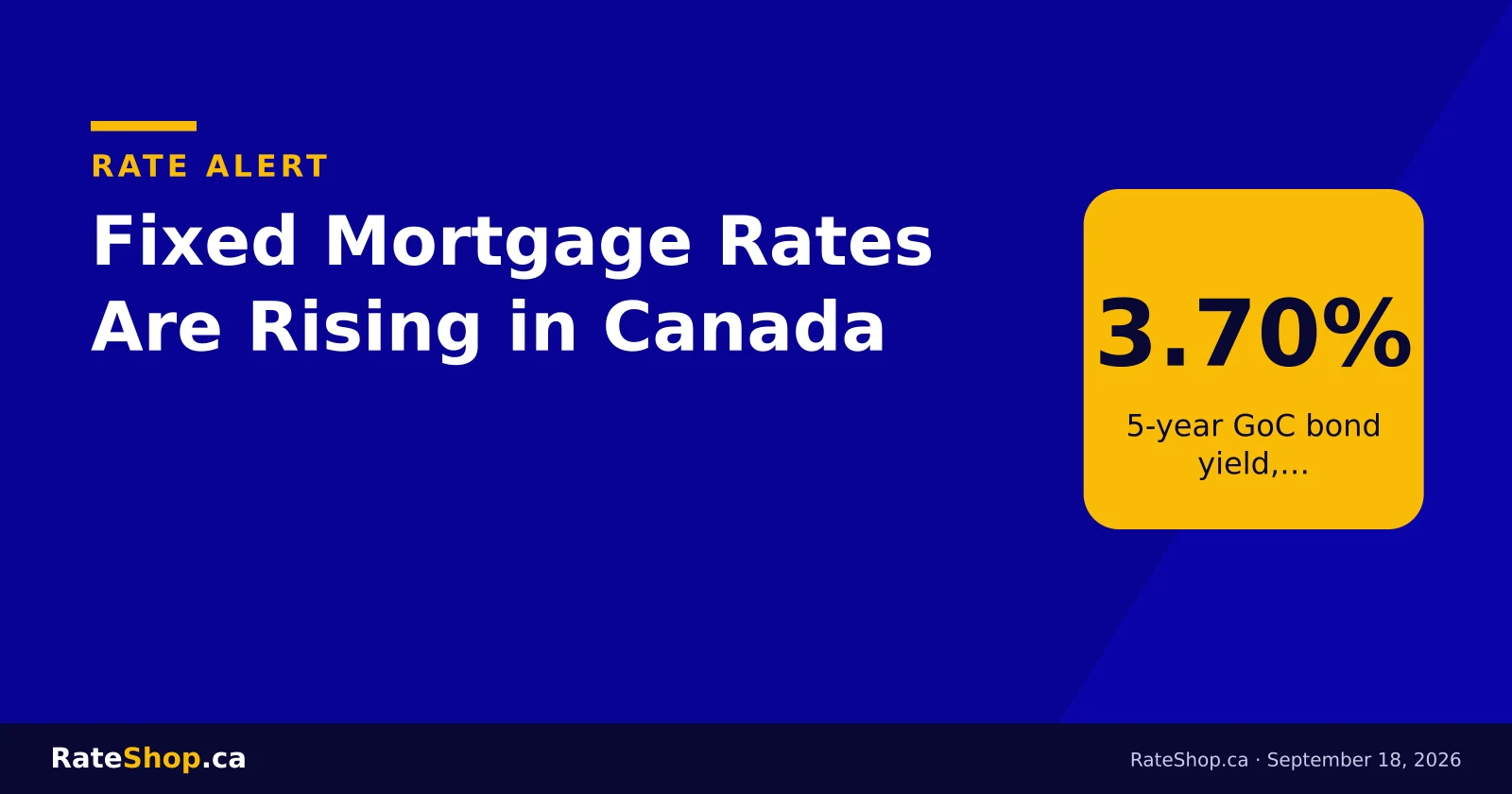
Rate alert, September 18, 2026. Fixed mortgage rates in Canada are moving up again. The five-year Government of Canada bond yield, the benchmark that sets fixed mortgage rates, climbed to roughly 3.65% to 3.70% this week, its highest level since 2024, and lenders have started passing that through: Ratehub's lowest advertised rates rose about 15 basis points in a week. The Bank of Canada's policy rate has not changed at all. It held at 2.25% on September 2 and prime stays at 4.45%, so variable-rate payments are untouched. If you are renewing in the next four months or shopping with a live pre-approval, this is the week to secure a rate hold.
Here is what moved, what it costs in dollars, and the specific steps worth taking before the next Bank of Canada decision on October 28.
Why fixed mortgage rates rise while the Bank of Canada holds
The two prices answer to different masters. The Bank of Canada's overnight rate sets lenders' prime rate, which drives variable mortgages and lines of credit. Fixed mortgage rates are funded in the bond market, so they track Government of Canada bond yields and the related funding benchmarks lenders use. Yields move daily on inflation expectations, energy prices, government borrowing and events outside Canada.
That is why fixed and variable pricing can move in opposite directions in the same week, which is exactly what has happened this month:
- Policy rate: held at 2.25% on September 2, 2026, the seventh consecutive hold. Prime remains 4.45% at most lenders.
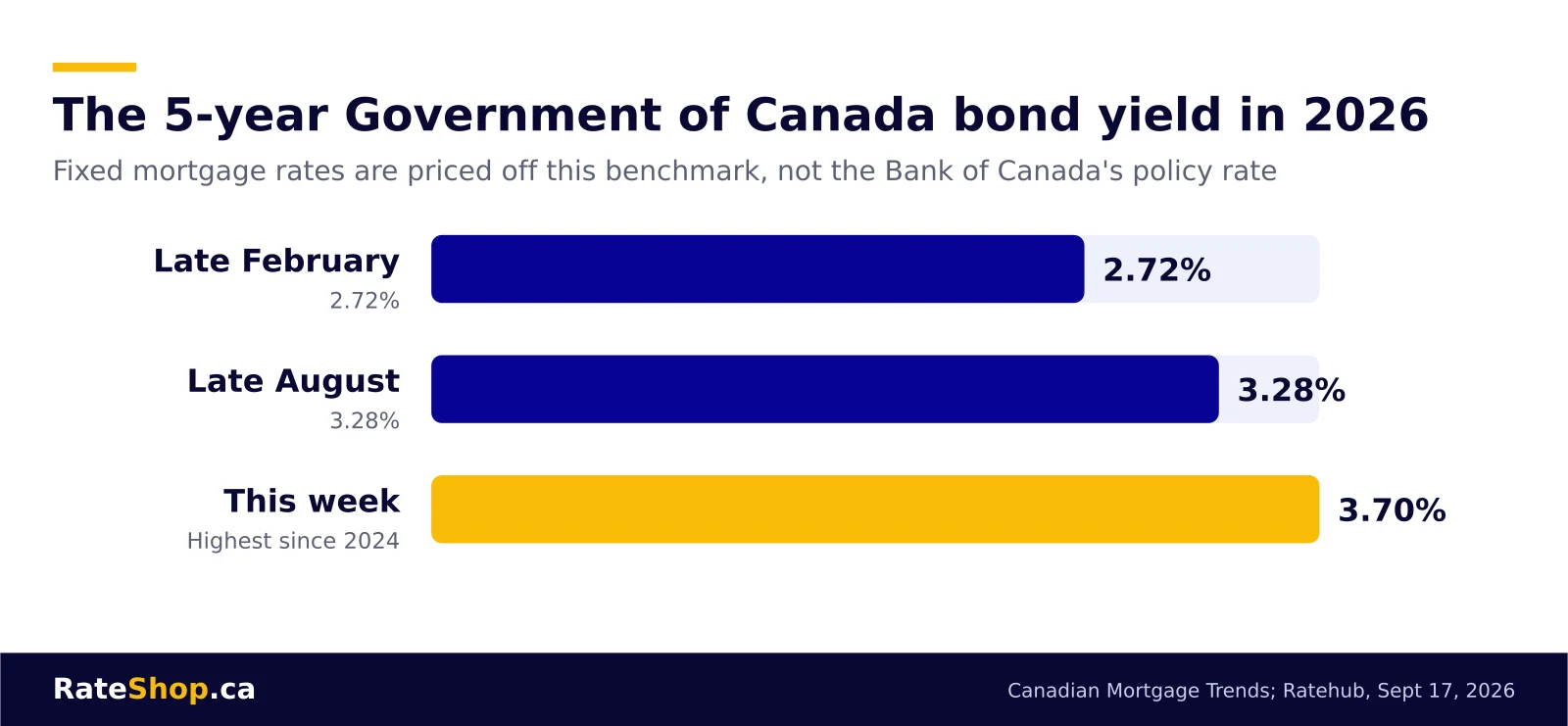
- Five-year GoC yield: around 2.72% in late February, about 3.28% in late August, and roughly 3.65% to 3.70% this week, the highest since 2024.
- Lender response: advertised fixed rates have begun to follow, with a reported 15-basis-point increase in the lowest rates over the past week. Shorter terms have held up better, with two- and three-year fixed rates still quoted below 4% at some lenders.
Commentary from bank economists this week tied the yield move to inflation worries, U.S. fiscal policy and oil prices, with a warning that sustained pressure on long-term yields would keep a lid on housing activity. That is analysis, not a forecast anyone can guarantee.
What the increase costs in dollars
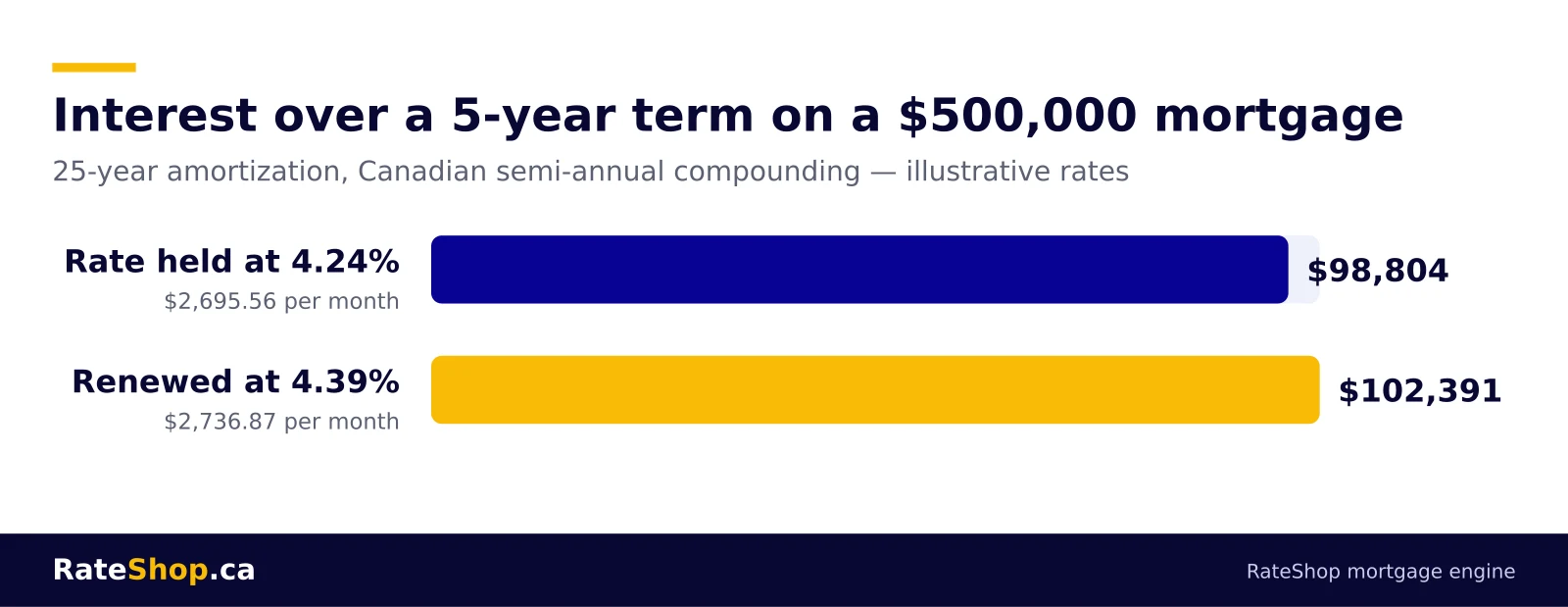
Fifteen basis points sounds trivial. On a real mortgage it is not, and it compounds over a full term. The table below prices a $500,000 mortgage with a 25-year amortization, using Canadian semi-annual compounding.
| Five-year fixed rate | Monthly payment | Interest over the 5-year term | Balance at end of term |
|---|---|---|---|
| 4.24% | $2,695.56 | $98,804 | $437,071 |
| 4.39% (+0.15) | $2,736.87 | $102,391 | $438,179 |
| 4.49% (+0.25) | $2,764.59 | $104,784 | $438,909 |
A 0.15-point move adds about $41 a month and $3,587 of interest over five years. A 0.25-point move adds roughly $69 a month and $5,980. That is the value of a rate hold secured before the next repricing, and the reason holds matter more in a rising market than in a falling one.
Fixed or variable, at today's spread
The gap between the cheapest fixed and variable pricing has widened as fixed rates climb and prime sits still. Using the lowest advertised high-ratio rates reported this week, a five-year fixed at 4.24% and a five-year variable at 3.40%, on the same $500,000 mortgage:
| 5-year fixed at 4.24% | 5-year variable at 3.40% | |
|---|---|---|
| Monthly payment today | $2,695.56 | $2,470.03 |
| Interest over five years | $98,804 | $78,809 if prime never changes |
| What changes it | Nothing until renewal | Every Bank of Canada decision, starting October 28 |
| Qualifying | Both are qualified at the greater of the contract rate plus two percentage points or 5.25% on uninsured mortgages | |
The variable column is not a prediction. It shows what today's rate would produce if prime stayed exactly where it is for five years, which it will not. Forecasts are split: most of the big banks expect the policy rate to hold through 2026, while a couple of forecasters see it rising to 2.75% by year-end. A variable mortgage saves money only while prime behaves; a fixed mortgage buys certainty at a premium that has grown this month. Run both against your own budget in the fixed vs variable calculator, and compare live pricing on 5-year fixed mortgage rates and 5-year variable mortgage rates.
Who this affects first
- Anyone renewing within 120 days. Your lender's renewal offer was priced off older bond levels. Get a competing hold now, before the offer expires and is repriced. Start with the mortgage renewal rates page and your maturity date.
- Buyers with an offer or a closing date. A pre-approval holds a rate, typically for 90 to 120 days. If yours is close to expiring, ask what a new hold would cost before you commit to a purchase price.
- Variable-rate holders. Nothing changed for you this month. Prime is unchanged at 4.45%. The question is whether locking into a fixed rate now, at a rate roughly 0.8 points above your variable, buys certainty you actually need.
- Anyone refinancing. Uninsured pricing is the highest of the three rate shelves, and a refinance is qualified as new lending. See mortgage refinance in Canada for how the math works before adding to the balance.
What to do this week
- Find your maturity date and current rate. Everything else follows from those two numbers.
- Secure a rate hold if you are inside 120 days. A hold protects the rate while you finish comparing; it does not commit you to that lender.
- Price the payment, not just the rate. Use the renewal calculator or the mortgage payment calculator to see the monthly figure before you sign anything.
- Compare shorter terms. With two- and three-year fixed rates still under 4% at some lenders, a shorter term can cost less today and leave you free to renew if yields fall.
- Ask when a renewal rate takes effect. If you renew early and the new, higher rate starts immediately rather than at maturity, you pay the increase months sooner. See the mortgage renewal guide.
What could change the picture
The next scheduled Bank of Canada decision is October 28, 2026. It sets prime, and therefore variable rates, not fixed ones. Fixed mortgage rates will keep following bond yields, which respond to inflation data, energy prices and trade policy between now and then. If yields retreat, lenders usually pass along fixed-rate cuts more slowly than increases; if yields hold near current levels, expect more lenders to reprice upward in the coming weeks. Treat any forecast, including the ones quoted above, as a scenario rather than a plan.
Frequently asked questions
Why are fixed mortgage rates going up when the Bank of Canada is on hold?
Because fixed mortgage rates are priced off Government of Canada bond yields, not the policy rate. The five-year yield has risen to about 3.65% to 3.70%, its highest since 2024, and lenders reprice fixed rates when their funding costs move. The policy rate held at 2.25% on September 2, so prime and variable rates are unchanged.
Should I lock in a rate now?
If you are within 120 days of a maturity or closing date, securing a hold costs nothing and protects you against further increases. Whether to choose fixed or variable depends on your budget's tolerance for payment changes, not on a rate forecast.
How long does a mortgage rate hold last?
Commonly 90 to 120 days, depending on the lender and whether the mortgage is insured. A hold protects the rate; you still have to satisfy the lender's approval conditions before funding.
Do rising fixed mortgage rates affect the stress test?
Yes, indirectly. Uninsured borrowers qualify at the greater of the contract rate plus two percentage points or 5.25%, so a higher contract rate raises the qualifying rate and trims the maximum mortgage you can carry.
Will my variable payment change this month?
No. Variable rates follow prime, which is set from the Bank of Canada's policy rate. Prime remains 4.45% at most lenders until at least the October 28 decision.
The bottom line
Fixed mortgage rates are rising because bond yields are, not because the Bank of Canada moved. The cost of waiting is measurable: about $3,600 over five years on a $500,000 mortgage for each 0.15-point increase. Borrowers with a maturity or closing date inside four months gain the most from acting this week, and lose nothing by holding a rate while they compare.
Next step: compare today's mortgage rates across lenders, or get matched with a licensed mortgage broker to hold a rate while you review your options.
How we sourced this: Bond yield levels, advertised rate movements and the fixed-variable spread are as reported by Ratehub and national media on September 17, 2026; the policy rate and prime are from the Bank of Canada's September 2, 2026 decision. Payment figures are calculated with RateShop's mortgage engine using monthly payments and Canadian semi-annual compounding on a $500,000 mortgage with a 25-year amortization. Rates in the examples are illustrative of market levels, not quotes. RateShop's own published board was last updated September 8, 2026. See our editorial policy.
This is general information, not financial advice. The rate you qualify for depends on your credit, income, down payment, property and lender. A licensed mortgage professional can review your situation.
Sources
- Bank of Canada: Policy rate announcement, September 2, 2026
- Ratehub: Best mortgage rates in Canada (September 17, 2026)
- The Globe and Mail: Higher mortgage rates add pressure on housing prices (September 17, 2026)
- nesto: Canadian mortgage rate forecast and bond yield tracking
Rates change monthly. Your inbox should too.
One short email when the market moves — Bank of Canada decisions, bond yields, and what they mean for your renewal.
We email you once to confirm. Nothing is sent until you click it.
