
Vendor Take-Back Mortgage: The $85,000 Balloon That Refinances $27,509 Short
Seller financing adds $340,000 of buying power on an $850,000 purchase, then needs 4.05% of appreciation in two years to get you out of it.
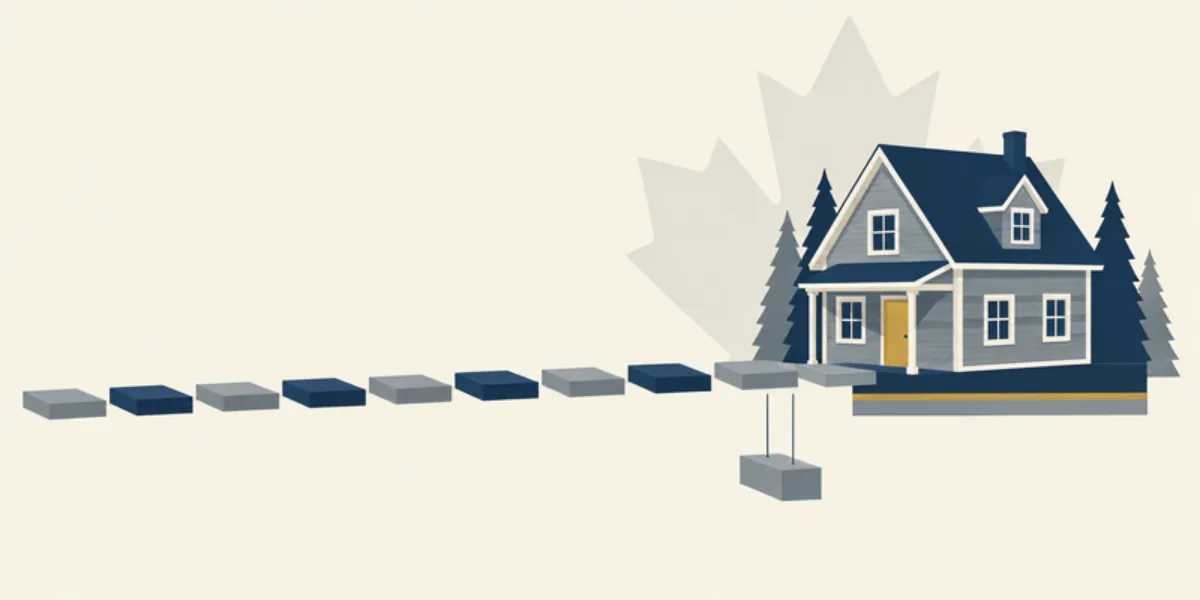
Thursday, 12 November 2026 — the bottom line. A vendor take-back mortgage lets the seller lend you part of the purchase price. On an $850,000 purchase with $127,500 of your own cash and an alternative lender capped at 75% loan-to-value, it moves your ceiling from $510,000 to $850,000 — $340,000 of buying power for about $557 a month. The catch is the exit. Two years later, with the property still worth exactly what you paid, refinancing to 80% opens only $57,491 of room against an $85,000 balloon. You land $27,509 short. A vendor take-back mortgage is a bet on the value rising, not on your mortgage shrinking.
For context, with every figure dated: the Bank of Canada's policy rate is 2.50% following the 25-basis-point increase announced on 28 October 2026, prime is 4.70%, the best advertised insured five-year fixed rate is 4.44% as at 10 November, and the five-year Government of Canada benchmark bond yield closed at 3.35% on 9 November. The next scheduled Bank decision is 9 December 2026.
How a vendor take-back mortgage actually works
The seller does not hand you cash. You close, title transfers to you, and the seller registers a charge against the property for the amount they agreed not to be paid on closing. That charge sits behind your institutional first mortgage, which makes the seller a second mortgagee with all of the risk that position carries.
Terms are negotiated, not posted. One to three years is typical, interest-only is typical, and the full principal comes due at maturity as a single balloon payment. The paperwork is a promissory note plus a registered charge, drawn by lawyers on both sides.
Two rules are not negotiable. Your first lender must consent in writing — most standard mortgage documents either prohibit further charges or require approval — and the vendor take-back must be disclosed to that lender and to any insurer. Concealing it is mortgage fraud, not a technicality.
What a vendor take-back mortgage buys you: $340,000 of price
The arithmetic is the whole argument. You have $127,500. An alternative lender will advance 75% of value, which means your own cash has to cover the other 25%. Without seller financing, $127,500 at 25% caps you at a $510,000 purchase. With the seller carrying 10% of the price, the same cash reaches $850,000.
| Piece of the $850,000 purchase | Amount | Share of price |
|---|---|---|
| Your own down payment | $127,500 | 15.00% |
| Alternative lender first mortgage (75% LTV) | $637,500 | 75.00% |
| Vendor take-back second mortgage | $85,000 | 10.00% |
| Combined loan-to-value | $722,500 | 85.00% |
At an illustrative 6.49% on a three-year fixed with a 30-year amortization, the first mortgage runs $3,989.25 a month. The vendor take-back at an illustrative 8.00%, interest-only, adds $557.45. Total carrying cost before taxes and heat: $4,546.70. The $340,000 of extra price costs you $163.95 a month per $100,000 — cheap, right up until maturity.
Those three rates are illustrative assumptions, not market quotes. Alternative-lender and seller-financing pricing is not posted anywhere, it is negotiated file by file, and your own numbers will differ. The insured 4.44% above is a verified market rate; 6.49%, 8.00% and the 11.49% below are not.
Why the insured route is closed to you
You cannot combine a vendor take-back mortgage with mortgage default insurance. CMHC requires a down payment from traditional sources — savings, proceeds from selling a property, or a non-repayable gift from a relative. Borrowed funds fall under its non-traditional category, and CMHC's own condition is that non-traditional down payments "must be arm's length and not tied to the purchase and sale of the property." Money lent by the person selling you the house is tied to that sale by definition.
So a vendor take-back lives behind an uninsured first mortgage, which in practice means a B lender, a credit union or a private first. That is a different cost base, not a discount: see how A, B and private lenders price the same borrower before you assume the structure is free. If your income is the obstacle rather than your down payment, the stress test still applies to the first mortgage at the contract rate plus two percentage points.
Next to a private second, the seller's money is cheap
The alternative to a vendor take-back is usually a private second from a mortgage investment corporation, and that comparison is where seller financing earns its place. Private seconds carry lender and broker fees that a vendor take-back generally does not.
| $85,000 second mortgage, 24 months | Vendor take-back | Private second |
|---|---|---|
| Rate (illustrative, interest-only) | 8.00% | 11.49% |
| Monthly payment | $557.45 | $795.05 |
| Interest over 24 months | $13,378.72 | $19,081.20 |
| Lender and broker fees | $0 | $2,550.00 |
| Total cost of the money | $13,378.72 | $21,631.20 |
The gap is $8,252.48 over two years, and the private option's all-in cost works out to 12.72% a year once the 3% fee is spread across the term. Fees are what make private money expensive, far more than the headline rate. For how a second ranks against a line of credit on the same equity, see second mortgage versus HELOC.
The exit is the entire deal
The vendor take-back exit is the part that gets skipped. At month 24 your $85,000 balloon is due in full, and the plan is almost always "refinance it into the first mortgage." Run that.
Your $637,500 first mortgage, at 6.49% over 30 years, amortizes down to $622,508.75 after 24 months. You have paid off $14,991.25 of principal. Refinancing an uninsured mortgage caps you at 80% of value. On a property still worth $850,000, that is $680,000, of which $622,508.75 is already spoken for.
| Value at month 24 | 80% of value | Room above the first mortgage | Against the $85,000 balloon |
|---|---|---|---|
| $807,500 (−5%) | $646,000 | $23,491 | $61,509 short |
| $833,000 (−2%) | $666,400 | $43,891 | $41,109 short |
| $850,000 (flat) | $680,000 | $57,491 | $27,509 short |
| $867,000 (+2%) | $693,600 | $71,091 | $13,909 short |
| $884,426 (+4.05%) | $707,540 | $85,031 | clears, by $31 |
| $901,000 (+6%) | $720,800 | $98,291 | $13,291 spare |
The break-even is 4.05% of appreciation over two years, or 2.00% a year. Below that you are writing a cheque, selling, or asking the seller for an extension they are under no obligation to grant. On a flat value, waiting for amortization alone to open $85,000 of room takes 62 months — five years and two months, not two.
There are three honest fixes, and all of them cost money now rather than later. Negotiate a three-year term instead of two, which cuts the flat-value shortfall to $19,264. Pay an extra $1,077.41 a month against the first mortgage, which closes the gap exactly by month 24. Or size the vendor take-back at what amortization will actually release — roughly $57,000 on these numbers — and find the rest of the purchase price elsewhere.
What the seller is signing up for
If you are the one carrying the paper, the interest is real income and the risk is real too. The $13,378.72 of interest over two years is fully taxable at your marginal rate in the year you receive it, not a capital gain. At a 43.41% marginal rate that leaves about $7,571.
On the gain itself, a vendor take-back can help if the property is not your principal residence. The capital gains reserve under paragraph 40(1)(a)(iii) of the Income Tax Act lets you spread a gain over a maximum of five tax years, with at least 20% brought into income each year, provided the proceeds are actually received over that period. A principal residence is normally exempt anyway, so the reserve does nothing for it. Confirm the treatment with your accountant before it influences the price.
Three legal points are routinely stated wrongly. Section 4 of the Interest Act, which caps undisclosed sub-annual rates at 5% a year, expressly excludes mortgages on real property — it does not protect you here. Section 6 does: a blended-payment mortgage must state the principal and the rate, calculated yearly or half-yearly and not in advance, or no interest is recoverable. Section 8 bars any higher rate on arrears than the rate on principal not in arrears. And section 10's right to prepay after five years is no help on a two-year term.
Before you sign a vendor take-back
- Get the first lender's written consent to secondary financing before you waive conditions, not after.
- Model the exit at a flat value and at minus 5%, not at the appreciation you are hoping for.
- Ask for a term long enough that amortization does most of the work — three years beats two by $8,245 of principal.
- Negotiate a written extension or renewal option into the charge, priced now, rather than relying on goodwill at maturity.
- Confirm there is no prepayment penalty on the vendor take-back, so an early refinance costs you nothing.
- Check that the second mortgage payment still fits your debt-service ratios — on these numbers, actual payments need about $139,001 of income at 44% total debt service, and $161,967 if the first is stress-tested.
- Budget for a second registered charge: two sets of legal fees, registration and title insurance.
- Price a private second in parallel, fees included, so you know what the seller's terms are worth.
Common questions
Can a vendor take-back cover my whole down payment?
Not on an insured mortgage, where the down payment must come from your own resources or a gift and must not be tied to the sale. On an uninsured purchase it is the first lender's policy that decides, and most cap combined loan-to-value at 80% to 85%. The structure above uses 15% of your own cash precisely because nobody will finance all of it.
What rate should a vendor take-back charge?
It tracks private second-mortgage pricing, because that is the risk the seller is taking, not bank pricing. The 8.00% used here is an illustrative assumption. The useful benchmark is what a private second would cost you with fees included — 12.72% a year on this file — since that is the seller's actual competition.
What happens if I cannot pay the balloon?
The seller can enforce the charge, and provincial timelines govern how fast. In practice they have a weak hand: to protect a second position they generally have to pay out the first mortgage in full, which most sellers cannot do. That makes an extension likely but not certain, and it is a poor thing to plan around. Decide at the start that the exit is yours to fund.
Rates change monthly. Your inbox should too.
One short email when the market moves — Bank of Canada decisions, bond yields, and what they mean for your renewal.
We email you once to confirm. Nothing is sent until you click it.
Keep reading
MLI Select: Why 95% Loan-to-Value Is Out of Reach on a Six-Unit Building
MLI Select is sold on 95% loan-to-value and a 50-year amortization. On a $1,800,000 six-unit building, CMHC's 1.10 debt coverage ratio caps the loan at $1,486,256 — 82.57% of value — and the route to 100 points can shrink it further.

Stated Income Mortgage in Canada: What the 90% Ceiling and the 5.85% Premium Actually Cost
A stated income mortgage caps out at 90% loan-to-value and costs 2.75 points more premium than documenting the same income: $17,325 on a $700,000 buy.

Construction Mortgage in Canada: Why Your $600,000 Build Only Advances $540,000 Before You Move In
A construction mortgage does not fund your build - it reimburses work an appraiser has certified as finished, less a 10% holdback. On a $600,000 fixed-price build against an $850,000 as-completed appraisal, that is $540,000 advanced before you move in, $17,717 of construction-period interest, and $6,000 riding on every percentage point of certified completion.
