
Rental Property Mortgage in Canada: Why the Insured Route Costs You $141,677 of Buying Power
The CMHC Income Property route caps amortization at 25 years and counts half your rent, qualifying the same borrower for $777,691 against $919,368 uninsured - and its 2.90% premium only pays back above a 74 bps spread.
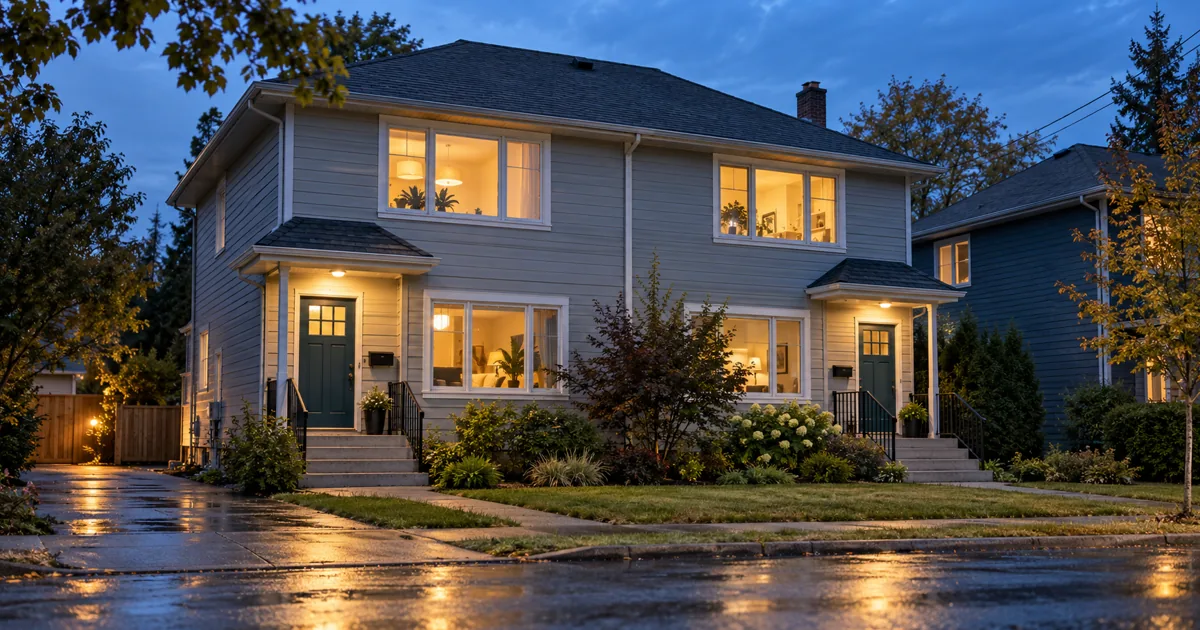
Toronto, 20 October 2026 — The bottom line: a rental property mortgage on a non-owner-occupied duplex needs 20% down, and that down payment is the easy part. The test that decides your file is income, not equity. On an $800,000 duplex renting for $4,400 a month, a borrower earning $110,000 with a $600 car payment qualifies for a purchase price of $777,691 through the insured CMHC Income Property route and $919,368 through an ordinary uninsured lender — a gap of $141,677. The insured route, the one built specifically for rental investors, is the one that buys you the least. Here is the arithmetic, run against rates in effect 19 October 2026.
What a rental property mortgage requires in 2026
Every rental property mortgage in Canada splits on one question: do you live in the building. Owner-occupied properties keep access to high-ratio insurance and small down payments. The moment nobody in the deal is moving in, the minimum equity jumps to 20%.
| Property | Minimum down | Insurance available | Max amortization |
|---|---|---|---|
| Owner-occupied, 1–2 units | 5% of first $500,000, 10% above (under $1.5M) | Yes, to 95% LTV | 25 yr (30 yr for eligible buyers) |
| Owner-occupied, 3–4 units | 10% | Yes, to 90% LTV | 25 yr (30 yr for eligible buyers) |
| Non-owner-occupied, 1 unit | 20% | No insured program | Lender-dependent, commonly 30 yr |
| Non-owner-occupied, 2–4 units | 20% | Yes, CMHC Income Property to 80% LTV, value under $1,000,000 | 25 yr insured |
Two things in that table do most of the damage. The insured rental programme caps property value at $1,000,000, which rules it out across much of the Greater Toronto and Vancouver markets, and caps amortization at 25 years where the uninsured route commonly offers 30. That second limit is worth more than most investors assume.
The stress test applies either way: you qualify at the greater of your contract rate plus two percentage points or 5.25%, under the same federal rules that govern owner-occupied files. Our guide to the 2026 stress test covers the mechanics.
How lenders count your rent, and why it decides everything
Every rental property mortgage turns on a single choice the lender makes: how much of your gross rent counts, and whether it lands in your income or against your expenses. Three methods are in use, and they are not close to equivalent.
Offset. A set share of gross rent is applied against the property's carrying costs, and only a shortfall counts against you. Insured A-lender files generally use 50% to 70%; conventional A-lender files run 50% to 80%.
Gross rent inclusion. Under CMHC Income Property, up to 50% of the subject property's gross rent is added to your qualifying income, and property taxes and heat can be excluded from your debt ratios entirely.
Add-back. A share of gross rent is added straight to income, then tested against the lender's debt limits. B lenders and some credit unions use 70% to 100%, which is why they approve files an A lender declines.
Lenders use the lower of your actual lease or an appraiser's market rent letter, so a below-market tenant caps your file at the lease. Expect to produce leases, a market rent letter, and last year's T776 for any rental you already own.
The $800,000 duplex: three routes, three answers
Same property, same borrower, three lenders quoting the same rental property mortgage. A legal duplex at $800,000, two units at $2,200 each, $6,000 a year in property tax, $150 a month in heat. The borrower earns $110,000, carries a $600 car payment, and has $160,000 down. Contract rates below are illustrative assumptions drawn from October 2026 market ranges — 4.50% to 5.50% for A-lender rental files and 5.50% to 7.00% for B-lender files — and are not quotes.
| Route | Loan | Rate / amortization | Payment | Qualifying rate | TDS | Result |
|---|---|---|---|---|---|---|
| A — CMHC Income Property (insured) | $658,560 incl. premium | 4.79% / 25 yr | $3,751.87 | 6.79% | 45.1% | Declined, cap is 44% |
| B — Uninsured A lender, 50% offset | $640,000 | 5.29% / 25 yr | $3,828.63 | 7.29% | 39.8% | Approved |
| B — Uninsured A lender, 50% offset | $640,000 | 5.29% / 30 yr | $3,527.22 | 7.29% | 36.9% | Approved |
| C — B lender, 80% add-back | $640,000 | 6.24% / 30 yr | $3,903.37 | 6.24% | 40.6% | Approved, 1% fee ($6,400) |
Read the first row again. The insured rental programme declines the file at a 45.1% total debt service ratio while the cheaper-looking uninsured file clears at 36.9%. Nothing about the borrower changed. The insured route failed because a 25-year amortization at a 6.79% qualifying rate produces a payment of $4,527.59, and adding 50% of gross rent to income does not cover the difference.
Does the rent actually cover your rental property mortgage
Approval and cash flow are separate questions, and the second is where investors get hurt. Carry below is payment plus $500 tax, $150 heat and $100 insurance.
| Route | Payment | Monthly carry | Net at $4,400 rent | Net after 5% vacancy |
|---|---|---|---|---|
| Insured, 4.79% / 25 yr | $3,751.87 | $4,501.87 | −$101.87 | −$321.87 |
| Uninsured, 5.29% / 30 yr | $3,527.22 | $4,277.22 | +$122.78 | −$97.22 |
| Uninsured, 5.29% / 25 yr | $3,828.63 | $4,578.63 | −$178.63 | −$398.63 |
| B lender, 6.24% / 30 yr | $3,903.37 | $4,653.37 | −$253.37 | −$473.37 |
Only one of the four is positive, and it turns negative once you allow 5% for vacancy — before a single repair. You need $2,139 per unit to cover carry on the best of these, against the $2,200 the units rent for. That is a 3% margin on an asset you are leveraged four to one against, and nothing in the rent is paying you for your time.
Where the insured rental property mortgage loses $141,677
Run the same borrower backwards and ask what each rental property mortgage route will actually finance.
| Route | Rent counted | Amortization | Max purchase price | Down payment needed |
|---|---|---|---|---|
| CMHC Income Property (insured) | 50% into income | 25 yr | $777,691 | $155,538 |
| Uninsured A lender | 50% offset | 25 yr | $867,075 | $173,415 |
| Uninsured A lender | 50% offset | 30 yr | $919,368 | $183,874 |
| B lender | 80% add-back | 30 yr | $1,043,885 | $208,777 |
The insured route sits last. Against the uninsured 30-year it gives up $141,677 of purchase price, and against a B lender, $266,194. The five extra years of amortization are worth more to your approval than the insurance is, because the stress test is applied to the payment and a longer amortization makes the payment smaller.
What the premium costs, and when it pays
The premium on an insured rental property mortgage is steep. At 80% loan-to-value it is 2.90% of the loan, against 4.00% at most on an owner-occupied high-ratio file at 95%.
| Loan-to-value | Down payment on $800,000 | Premium rate | Premium | Total insured loan |
|---|---|---|---|---|
| Up to 65% | $280,000 | 1.45% | $7,540 | $527,540 |
| 65.01% to 75% | $200,000 | 2.00% | $12,000 | $612,000 |
| 75.01% to 80% | $160,000 | 2.90% | $18,560 | $658,560 |
The premium can be added to the loan. The provincial sales tax on it cannot — in Ontario that is 8% of $18,560, or $1,485 in cash at closing, on top of your down payment and land transfer tax.
So the premium has to buy you something. Compare total five-year cost — sixty payments plus the balance still owed at the end — on the insured loan at 4.79% against an uninsured loan of $640,000 at the same 25-year amortization. The insured file costs $806,045. Break-even lands at 5.53%: an insured rental property mortgage only comes out ahead if your uninsured alternative is priced at least 74 basis points higher. The verified A-lender rental range in October 2026 spans 100 basis points in total, so that spread is available on some files and absent on most. Ask for both quotes and do the subtraction before you accept the premium.
Moving from 80% to 75% loan-to-value is the cheaper lever. An extra $40,000 down cuts the premium from $18,560 to $12,000 and the payment from $3,751.87 to $3,486.62.
When a B lender is the right answer
A B-lender rental property mortgage buys capacity, not savings. The 80% add-back lifts the same borrower to $1,043,885 of purchase price, and B lenders qualify at the contract rate rather than the stressed rate, which is most of where the extra room comes from. You pay for it: roughly 100 to 175 basis points of rate on October 2026 ranges, plus a lender fee commonly around 1%, which is $6,400 on this loan.
That trade is worth making on a one-to-two-year term when the file is temporarily unqualifiable and has a clear route back — a new rental with no T776 history, a self-employed borrower whose income has not yet seasoned, or a portfolio that has outgrown an A lender's door count. It is a poor trade as a permanent home. Our breakdowns of B lender costs and requirements and qualifying while self-employed go through the pricing in detail.
Where the down payment comes from matters too. Borrowing it against your existing home changes your debt ratios on the new file, which our comparison of a second mortgage against a HELOC works through.
The rate backdrop a rental property mortgage prices off
The Bank of Canada has held its policy rate at 2.25% since the 2 September 2026 decision, with prime at 4.45% as of 19 October. September inflation, released 19 October, came in at 3.1% year over year, up from 3.0%, but almost entirely on gasoline — up 27.8%, contributing 1.1 percentage points on its own. The Bank's own core measures eased, with CPI-trim at 1.8% and CPI-median at 1.9%. Shelter rose 1.8% and rent 2.8%, while mortgage interest costs fell 0.2%.
The five-year Government of Canada bond yield, which drives fixed pricing, sat at 3.54% on 16 October. The next decision is 28 October, alongside a Monetary Policy Report. Market expectations currently lean toward a hold with gradual increases through 2027, and those expectations can change with any data release — treat them as a scenario to stress your rental property mortgage against, not a forecast to plan on.
What to do before you make an offer
- Ask every lender which rent method they use and at what percentage. "We use rental income" is not an answer; "50% offset" and "80% add-back" are different approvals.
- Price the insured and uninsured versions of the same rental property mortgage side by side. If the uninsured quote is less than 74 basis points above the insured one, the 2.90% premium is costing you money.
- Ask for the 30-year amortization quote explicitly on uninsured files. On this duplex it moved the total debt service ratio from 39.8% to 36.9%.
- Check the $1,000,000 value ceiling before you count on the insured route at all.
- Budget the premium sales tax as closing cash — $1,485 here, and it cannot be financed.
- Get a market rent letter from the appraiser, not just the lease. A below-market tenant caps your qualifying rent.
- Model the carry at 5% vacancy and 5% maintenance before you sign, not at full rent.
- If you need a B lender, write the exit before you fund it, with the specific condition that gets you back to A pricing.
Common questions
Can I buy a rental property with less than 20% down?
Only by living in it. An owner-occupied duplex can go to 95% loan-to-value, and an owner-occupied triplex or fourplex to 90%, with the rent from the other units still counted toward qualifying. A property nobody in the deal occupies needs 20%, with no exception from any of the three insurers.
Is a rental property mortgage rate higher than on my own home?
Yes, typically by 50 to 100 basis points on October 2026 ranges. A-lender rental files ran roughly 4.50% to 5.50%, against a best insured five-year fixed of 4.59% for owner-occupied and Big Six uninsured five-year fixed pricing of 5.39%. Rates change daily and vary by file, so treat these as ranges rather than quotes.
Does rental income on a property I already own help or hurt my next approval?
It depends on the method. Under an offset, a property carrying itself is roughly neutral and a shortfall becomes a liability on your ratios. Under an add-back, a share of the gross rent increases your income regardless of what the property nets. Two lenders can look at the same rental you already own and reach opposite conclusions, which is the strongest argument for shopping a rental property mortgage across lenders rather than renewing where you are.
Figures in this article reflect rates and data published as of 19 October 2026 and change without notice. Worked scenarios use illustrative contract rates drawn from published October 2026 market ranges and are not quotes or offers of credit. Your own rate, qualification and approval depend on your lender's assessment of your file.
Rates change monthly. Your inbox should too.
One short email when the market moves — Bank of Canada decisions, bond yields, and what they mean for your renewal.
We email you once to confirm. Nothing is sent until you click it.
Keep reading

Private Mortgage Exit Strategy: The 12-Month Plan to Get Back to a B or A Lender
A private mortgage is priced on the assumption that you leave. Three rollover years cost $210,018 and retire no principal; exiting to a B lender after one costs $60,205 less. The twelve-month plan that gets the exit approved.

Reverse Mortgage in Canada: What Deferring Every Payment Actually Costs
Reverse mortgages let Canadians 55+ draw up to 55% of their home's value with no monthly payment. We model what the balance actually does over 5, 10, 15 and 20 years, and compare it against a HELOC and a refinance.

Bridge Financing in Canada: What the Gap Between Closing Dates Actually Costs
Bridge financing is priced off prime, now 4.45%, plus a $250-$500 set-up fee. On a 15-day gap that fee is 45% of your cost, which inverts the usual advice: negotiate the fee, not the rate.
