
Cash-Out Refinance in Canada: Your Income Caps You $77,512 Below the 80% Ceiling
The Bank Act caps a refinance at 80% of value, which on a $900,000 home with a $480,000 balance offers $240,000 of equity out — but a $140,000 household qualifies for $642,488, so the real takeout is $162,488 and the binding constraint is income, not the property.
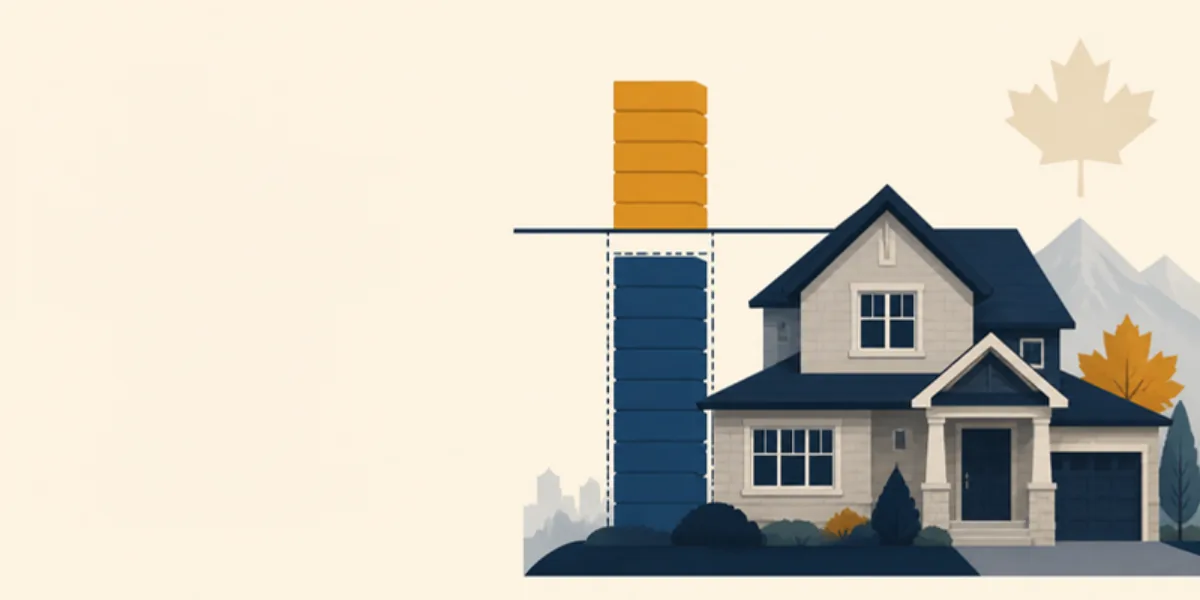
Friday, 30 October 2026. The bottom line: the 80% loan-to-value ceiling on a cash-out refinance is federal law, but it is almost never the number that stops you. On a $900,000 home with a $480,000 balance, the 80% line allows a $720,000 mortgage and $240,000 of equity out. A household earning $140,000 qualifies for $642,488 — so the real takeout is $162,488, which is 32.3% less than the equity math promised. The Bank of Canada raised its policy rate 25 basis points to 2.50% on 28 October and prime moved to 4.70% the next day. The lowest advertised uninsured five-year fixed rate was 4.44% on 29 October, which means you qualify at 6.44%.
Most cash-out refinance advice stops at the arithmetic of your home's value. That arithmetic is the easy part, and it is the part that overstates what you will actually be handed at the lawyer's office.
The cash-out refinance ceiling is federal law, not lender policy
Section 418(1) of the Bank Act prohibits a federally regulated lender from making or refinancing a residential mortgage above 80% of the property's value. Section 418(2) exempts loans carrying default insurance. The practical effect is that no branch manager, broker or rate promotion can lift the line, because it is not the lender's line to lift.
The insured exemption does not help you here. Default insurance is available above 80% only for narrow purposes — chiefly a secondary-suite refinance to 90% of as-improved value, where the money has to finish a legal suite and cash take-out is not permitted, and an equity buy-out after a separation, which is a purchase of a co-owner's interest rather than a refinance. For a cash-out refinance that puts money in your account, there is no insured path above 80%.
So the cash-out refinance ceiling is fixed. What varies is how far below it you land.
What a cash-out refinance gives you on a $900,000 home
Take a home appraised at $900,000 with a $480,000 balance maturing now, so there is no prepayment penalty to work around.
| Step | Amount |
|---|---|
| Appraised value | $900,000 |
| 80% of value — statutory maximum mortgage | $720,000 |
| Existing balance | $480,000 |
| Gross equity available at the ceiling | $240,000 |
| Appraisal, legal and discharge costs | $2,100 |
| Net cash at the ceiling | $237,900 |
That $2,100 assumes you refinance at maturity. Refinance mid-term and a fixed-rate penalty is the greater of three months' interest or the interest rate differential, which on a low-rate mortgage written in 2021 can run into five figures and is deducted from your proceeds.
Your income caps a cash-out refinance before the 80% line does
A cash-out refinance is a newly underwritten mortgage, so the minimum qualifying rate applies: the greater of your contract rate plus 2% or 5.25%. At 4.44% you are tested at 6.44%, and the test runs against the whole new balance, not just the new money.
Gross debt service is capped at 39% of gross income, covering principal, interest, property tax and heat. With $5,400 of annual property tax and $100 a month of heat, here is what each income supports on a 30-year amortization.
| Household income | Maximum mortgage at 6.44% | Actual equity takeout | What binds you |
|---|---|---|---|
| $110,000 | $485,882 | $5,882 | Income |
| $125,000 | $564,185 | $84,185 | Income |
| $140,000 | $642,488 | $162,488 | Income |
| $155,000 | $720,000 | $240,000 | The 80% ceiling |
| $185,000 | $720,000 | $240,000 | The 80% ceiling |
The crossover sits at about $154,850. Below that income, every dollar of the gap between what you qualify for and the $720,000 ceiling is equity you own and cannot reach. At $110,000 the ceiling is irrelevant — the 80% line offers $240,000 and the stress test allows $5,882, which does not cover the closing costs.
This is why a cash-out refinance so often collapses late in the process. The homeowner has done the equity arithmetic, picked the renovation, and only then discovers that the binding constraint was never on the property side of the ledger. The Bank of Canada's May 2026 Financial Stability Report put roughly 4% of borrowers at risk of being unable to refinance at renewal in 2027, measured on exactly this combination: loan-to-value above 80%, gross debt service above 39%, total debt service above 44%.
Other debt moves the cap a second time
Total debt service is capped at 44% and includes car payments, lines of credit and credit card minimums. At $140,000 of income, GDS binds until your other obligations reach roughly $650 a month, after which TDS takes over.
| Other monthly debt | Binding ratio | Maximum mortgage | Equity takeout |
|---|---|---|---|
| $0 | GDS | $642,488 | $162,488 |
| $400 | GDS | $642,488 | $162,488 |
| $800 | TDS | $607,687 | $127,687 |
| $1,200 | TDS | $543,438 | $63,438 |
Note the shape of that. Carrying $1,200 a month of consumer debt costs you $99,050 of accessible equity. If clearing that debt is the point of the exercise, the sequencing matters more than the rate — we cover that case in detail in refinancing to consolidate debt.
The two levers that actually move the number
Amortization
Because a cash-out refinance is uninsured, amortization beyond 25 years is available. At $140,000 of income the difference is large.
A 20-year amortization supports $542,685 and a $62,685 takeout at a $3,403.91 payment. Twenty-five years supports $600,429 and $120,429 out at $3,303.21. Thirty years supports $642,488 and $162,488 out at $3,217.13. Stretching from 20 to 30 years nearly triples the cash you can reach and lowers the payment by $186.78 a month, at the cost of ten more years of interest.
The rate you qualify at
The minimum qualifying rate is your contract rate plus 2%, so a lower contract rate lowers the bar twice over. The lowest advertised uninsured five-year variable was 3.64% on 29 October, which tests at 5.64% rather than 6.44%. At $140,000 of income that supports $698,697 instead of $642,488 — $56,209 more equity out, on the same income and the same property.
That is a qualification advantage, not a prediction. The Bank's 28 October statement said there "could be a need to increase the policy rate further" while Governing Council "agreed to proceed carefully," and the next decision is 9 December. Market expectations about further increases can change, and a variable payment moves with prime.
What a cash-out refinance costs to carry
On the $162,488 that a $140,000 household can actually extract, at 4.44% over 30 years, that slice carries a payment of $813.63 a month and costs $34,223.47 in interest over five years. The balance on it after five years is $147,894.17, so you repay $14,594 of principal and $34,223 of interest in the first term.
Compare the alternative. A home equity line of credit is capped by Guideline B-20 at 65% of property value, which on this home is $585,000 — leaving $105,000 available rather than $240,000. A HELOC is cheaper to set up and lets you draw only what you need, but it is capped lower and priced off prime, now 4.70%. At an illustrative prime plus 0.50%, which is an assumption rather than a market quote, a $105,000 draw costs about $455 a month in interest alone and never amortizes. The second mortgage versus HELOC comparison sets out when leaving your first mortgage alone wins outright — which it often does when breaking carries a penalty.
Before you apply
- Work out your cash-out refinance qualifying number first, not your equity number. Take 39% of gross monthly income, subtract property tax and heat, and see what that payment supports at your contract rate plus 2%.
- Get a realistic value before you pay for an appraisal. A value $50,000 light costs you $40,000 of ceiling.
- Price the penalty if you are mid-term. Ask your lender for the discharge statement in writing — see how prepayment penalties are calculated.
- List every other monthly obligation before you apply, because TDS at 44% may be the binding ratio rather than GDS.
- Ask what amortization the lender will write. The gap between 25 and 30 years was $42,059 of borrowing power in the example above.
- Compare the fixed and variable qualifying rates side by side, since the 80-basis-point difference in the test is worth more than the headline rate gap in many files.
- Decide whether you need the full amount at once. If you do not, a lower-cost line may beat breaking a mortgage.
Common questions
Can I ever get a cash-out refinance above 80% of my home's value?
Not for cash in hand. The Bank Act caps uninsured refinances at 80%, and the insured programs that go higher are restricted to purposes such as completing a legal secondary suite or buying out a co-owner after a separation. Above 80% the remaining routes for a cash-out refinance are a second mortgage or private lending, both at higher rates and fees.
Does the stress test apply if I stay with my current lender?
Yes. The exemption applies to a straight switch at renewal with no increase to the loan amount and no increase to the amortization period. A cash-out refinance increases the loan amount by definition, so every cash-out refinance is newly underwritten and tested at your contract rate plus 2%. Our guide to when the stress test applies covers the exemptions.
Is the interest on a cash-out refinance tax-deductible?
Generally not. Interest follows the use of the funds, so borrowing against your home for a renovation or a vehicle is not deductible. Where the money is invested to earn income, interest may be deductible — the rules are specific and the paperwork matters, so confirm your situation with an accountant rather than assuming.
The equity on your statement and the equity a cash-out refinance can reach are two different numbers, and in most Canadian files the smaller one is set by your income rather than your address. Run the qualifying calculation before you plan what to spend.
Rates change monthly. Your inbox should too.
One short email when the market moves — Bank of Canada decisions, bond yields, and what they mean for your renewal.
We email you once to confirm. Nothing is sent until you click it.
Keep reading

Spousal Buyout Mortgage: The 60% Rule That Decides Whether You Keep the House
On a $620,000 home with a $420,000 joint mortgage, a refinance caps out $24,000 short of the payout. A spousal buyout mortgage reaches 95% of value instead of 80% - for a 2.80% premium and a 6.34% stress test.

Porting a Mortgage in Canada: What You Actually Keep When You Move
Porting a mortgage protects a fixed quantity of cheap money, not a rate. On a $480,000 balance at 2.89%, adding $140,000 of new money at 5.09% blends to 3.387% and still saves $552.06 a month against writing the whole $620,000 at today’s market rate.

Amortization Extension at Renewal: What Stretching to 30 Years Actually Costs
An amortization extension cuts a $3,442 renewal payment to $2,803 on a $520,000 balance at 5.09%. Over the five-year term that relief costs $5,158 in extra interest and $43,508 in equity you would otherwise have built. Here is the arithmetic, the rules on who can ask, and how to keep the option without paying for it.
