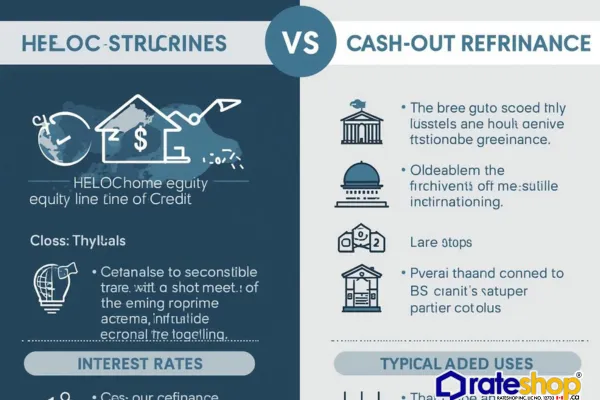
HELOC vs Cash-Out Refinance
H1: Home Equity Options: HELOC vs Cash-Out Refinance — What to Choose
H2: Introduction – The HELOC vs Cash-Out Refinance Dilemma
If you’re a homeowner sitting on built-up equity, you might be asking:What’s the best way to tap home equity in 2025? Two of the most popular choices are a Home Equity Line of Credit (HELOC) and a cash-out refinance. Both unlock the value of your home, but they work differently, with unique pros and cons.
At Rateshop, we often get asked: Should I use a HELOC or go with a cash-out refinance? The answer depends on your goals, financial situation, and even current mortgage rates.
In this guide, we’ll break down theHELOC vs cash-out refinance comparison, including:
HELOC interest rate variable vs cash-out refinance fixed rate structures
Which is better for home improvements, debt consolidation, or tuition
A real-world look at closing costs and repayment flexibility
H2: Understanding the Basics – HELOC vs Cash-Out Refinance
H3: What Is a HELOC?
A Home Equity Line of Credit works like a credit card secured by your home. You get a revolving credit line based on the equity you’ve built.
Repayment period: After the draw, repayment begins (often 10–20 years).
HELOC interest rate variable: Rates move with the prime rate, making payments flexible but unpredictable.
H3: What Is a Cash-Out Refinance?
A mortgage cash-out refi replaces your existing mortgage with a larger one, giving you the difference in cash.
Fixed-rate stability: Most choose a cash-out refinance fixed rate, which locks in predictable payments.
Lump sum: Funds are received upfront.
Impact on mortgage: Extends or resets your term, and you may lose your old low rate if you had one.
H2: Side-by-Side Comparison – Lump Sum vs Line of Credit
H2: Which Home Equity Option Fits Your Goals?
H3: For Home Improvements
HELOC: Great for phased renovations where costs come in stages. Example: adding a deck now, finishing a basement later.
Cash-Out Refinance: Ideal if you have a one-time large project (like a kitchen remodel) with fixed costs.
H3: For Debt Consolidation
Cash-Out Refinance Fixed Rate is often better, as it rolls high-interest debt into one predictable mortgage payment.
HELOC interest rate variable may start lower but could increase, making it risky for long-term consolidation.
H3: For Tuition or Education Costs
HELOC draw period flexibility works well for paying semester by semester.
But if you prefer a predictable fixed payment, a cash-out refinance may provide peace of mind.
📸Visual Placement #4 (Infographic)
H2: The Cost Factor – Closing Costs & Fees
One of the biggest differences between these two options is cost.
Cash-Out Refinance: Higher, sinceit’s a full refinance. Think appraisal, legal fees, title insurance, and potential penalties for breaking your old mortgage.
Tip: If your current mortgage rate is much lower than today’s average, a cash-out refinance may be expensive in the long run. (See thisBank of Canada mortgage rate tracker).
H2: When a HELOC Makes More Sense
You need flexibility, not a lump sum.
You want quick access to equity without disturbing your existing mortgage rate.
You expect rates to drop, making variable borrowing cheaper.
👉 Explore home equity line of credit options and find today’s best offers.
H2: When a Cash-Out Refinance Wins
You want predictable payments with a fixed rate.
👉 Use our quick mortgage quote tool to compare if refinancing saves you money.
H2: Common Questions About HELOC vs Cash-Out Refinance
H3: Is a cash-out refinance worth it if my current mortgage rate is low?
Usually not. You’d risk trading a low rate for a higher one. A HELOC might be better here.
H3: How does a cash-out refinance affect my existing mortgage term?
It resets your term—if you had 20 years left, you may now have a fresh 25- or 30-year mortgage.
H3: What’s cheaper in the short run?
H3: Can I combine strategies?
Yes—some homeowners do a partial cash-out refinance for debt consolidation and keep a small HELOC for future flexibility.
H2: Real-World Example – Choosing the Right Option
Let’s take “Sarah,” a homeowner in Ontario:
She owes $250,000 on a mortgage with a 2.1% rate from 2021.
Her home is now worth $600,000, and she needs $50,000 for renovations and $20,000 for her child’s tuition.
If she refinanced, she’d lose her 2.1% rate and replace it with today’s ~5.5%—doubling her monthly payments. Instead, aHELOC makes sense: she can borrow only what she needs, keep her low mortgage, and pay tuition in installments.
This scenario shows why home equity options comparison must be personalized.
H2: Conclusion – Which Option Should You Choose?
When it comes to HELOC vs cash-out refinance, there’s no universal answer. It depends on your goals, mortgage rate, and how you plan to use the funds.
Choose a HELOC if you value flexibility, phased spending, and want to keep your low mortgage rate intact.
Choose a cash-out refinance if you need a lump sum for debt consolidation or major expenses, and don’t mind resetting your mortgage.
👉 At Rateshop, we help homeowners compare home equity options side by side. Whether it’s ahome equity line of credit or a mortgage cash-out refi, our experts find the best strategy for you.
